

I have been struggling to get back into the flow of blogging lately. I spent a lot of yesterday thinking about what to write instead of actually writing. Normally, I just put pen to paper and write my way through it till something acceptable forms. But yesterday I had tons of GREAT ideas in my head that I didn’t feel so great about once I actually began writing them. I was overthinking what I was gonna say and how I was gonna say it which resulted in typing a few sentences and sighing at the sight of them. This inspired today’s topic: Writer’s block.
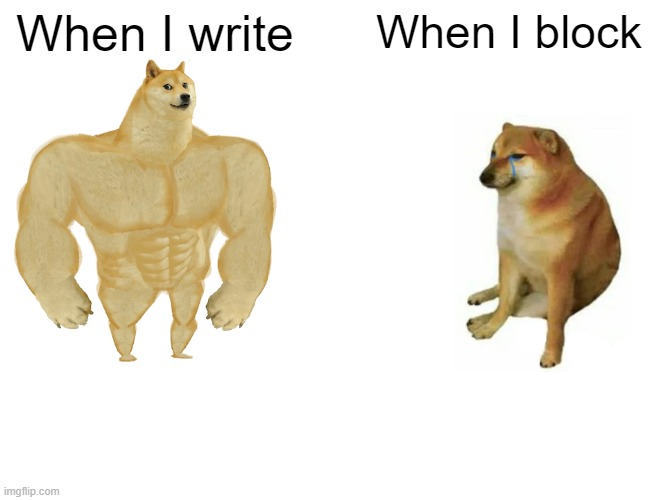
Is writer’s block unique to writers or do all of us face the pain of struggling to perform at our best or express ourselves fully?
Whether it’s writing a book, hosting a podcast, delivering a speech or playing sport, we all have our ‘off days’ i.e. times when the biggest barrier preventing you from finishing a task is yourself. When this happens, is your creative juice trapped in your bones refusing to escape? Do we need to take a break and dance it off to shake it back onto the page?
Or is it all in your head? Is ‘writer’s block’ just an annoying voice telling you that you can’t do it. Nobody will like it. It’s too difficult. Have a drink or two first. Fill up another coffee.
Stephen King is convinced fear is at the root of most bad writing. Many writers struggle to believe they’re good. Then others believe they’re too good to let themselves write badly.
My reaction to feeling ‘blocked’ has always been to write a load of nonsense down till I’m relatively happy with what emerges. Other writers suggest putting stories in the drawer for a while if writing becomes a tedious chore. But don’t we need to consistently work on our words to improve them?
Writing tampers with your self-esteem. You might feel comfortable sitting alone at a desk till you have to put yourself out there and share work with another human. It’s like preparing for a solo presentation; it’s all fun and games on PowerPoint till you’ve to stand in front of the room and hope they get it or at least appreciate the memes. Kevin Barry advised all beginner/upcoming writers to admit they are a writer first so they become comfortable telling people. Once you do, you start to believe it and it helps overcome the ‘block’.
You might be envious of successful writers and play a comparison game, which leaves you wanting to projectile vomit all over the keyboard (a beautiful image used by writer Louise Kennedy). According to Roxie Nafousi, envy is a natural human emotion but also a ‘low vibe’ frequency which prevents us from reaching our goals by feeding a ‘scarcity’ mindset. We can raise our ‘positive vibes’ when we use it as inspiration instead. For example:
ENVY: “UGH they got a publishing deal while I’m drowing in rejection emails. It’s not fair.”
INSPIRATION: “Oh, they got a publishing deal. Maybe I can too!”
Envy tells us a lot about our personal desires and goals. If we use the emotion to criticise ourselves and those around us, we will never feel satisfied. When I was at school, I fantasized about being a writer. But when I didn’t know all of the long impressive vocabulary words that rolled off my classmates’ tongues, I doubted my abilities. A comment that stuck with me:
“I thought you wanted to be a writer? How don’t you know what that word means?”
I didn’t read the newspaper everyday. I wasn’t a straight A student. I didn’t carry a dictionary in my pocket. I couldn’t (and still can’t) spell many words. I let this imaginary notion of what a writer ‘should be’ block me from sharing my writing for a long time. Then, eventually, with encouragement and a passion to persist, I allowed myself to write badly so I could get better. Even my MA in Creative Writing somehow wasn’t enough to convince me I CAN WRITE.
Yet here I am. Writing and sharing a blog about it. Because I realised putting myself out there and learning to sorta like what I write is more important than being blocked by writing to please others. Even if you don’t write, you might be blocked in another aspect of your life. Don’t let the fear of looking bad prevent you from trying. Use it as a ‘good kind of scary’ to fuel inspiration. 🙂
Suggestions for overcoming ‘blocks’:
- Journaling: Write down your thoughts and question the inner critic repeating limiting beliefs. I suggest Pat Divily’s book ‘Fit Mind‘ which includes 8 weeks of challenges to improve your self-esteem OR ‘The Artist’s Way’ – Julia Cameron shares weekly writing prompts to boost your creative ‘inner child’.
- Kit De Waal prioritises reading daily over writing daily. You will unconsciously start to develop your own writing by reading the words of others. Even if you don’t write, reading is a great resource to educate us in all areas of life. Audiobooks and podcasts are more readily available if you despise holding a physical book. My local library offers audiobooks and Ebooks for FREE.
- Pick a time of day that best works for you — first thing in the morning or late at night is when our brains are usually in a relaxed worry-free state, optimum for creativity and ‘flow’. But you need to schedule a time suitable for your personal routine.
- If it doesn’t feel fun, your reason ‘why’ better be good: Whether it’s a deadline for work or a long-term commitment, sometimes we just have to follow through with unenjoyable projects. But if you write in your freetime and you are your own boss, then remind yourself of why you are doing it. Make sure the work aligns with the ‘why’.
- Show up. Just show up.
 A Good Kind of Scary
I really love the idea that “daily reading” is more important than “daily writing” – it takes less pressure off the need to write when you’re stuck.
LikeLike